field guide
The Grow Field Guide
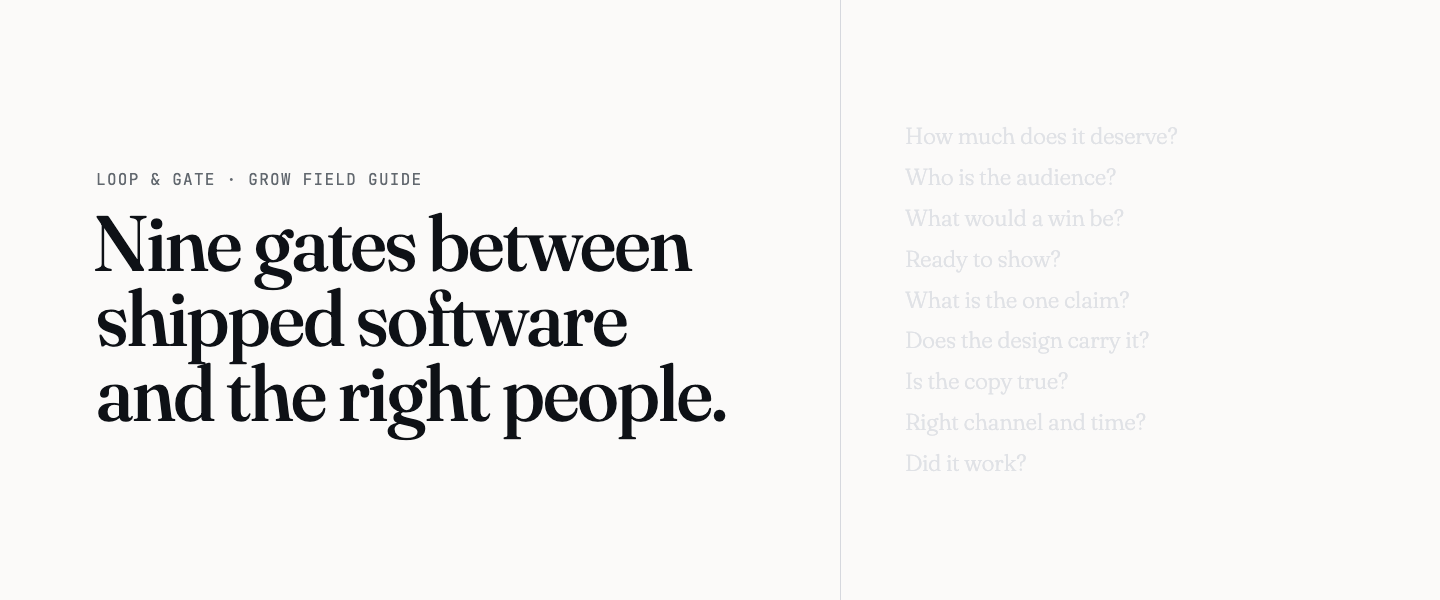
The grow-side gates cover taste, the one true claim, the right audience, and reading whether a piece worked.
How to read this guide
The tools that run a growth loop — the design generators, the copy assistants, the schedulers, the analytics dashboards — are commodities, and they churn every quarter. This guide is not about them. It is about the points where the loop has to stop and wait for a human, what you are actually deciding at each, and how to tell when the pipeline is confidently producing something polished and wrong.
There's a reason the gates fall where they do. Each one marks a place where the agent is weak. It can't tell tasteful from on-trend slop, it can't feel when a claim is technically true but sounds like a lie, it can't read which audience is actually yours, and left alone it will confidently blast a good message into the wrong channel at the wrong time. The gates are a map of the agent's blind spots on the grow side, and taste, truth, and audience are the sharpest blind spots it has. Where the tool is strong you let it run, and where it's blind you stop and decide.
You do not need all three grow lenses to use this. Some gates are design calls, some are copy calls, some are positioning calls, and almost nobody starts with all three instincts. This is the side I'm weakest on myself. I've spent years on the product and engineering side, but go-to-market is not my native lens, so I work these grow gates exactly the way a designer with no backend experience works the architecture gates on the build side: I lean on the structure and put the agent to work, and I get a little better every time I ship through them. If GTM isn't your strength either, you're in the right place, and you're in good company.
The one thing the framework can't do is learn the gate for you. It gets you to a defensible decision you couldn't have reached alone, but only if you treat each gate as something to understand, not something to skip. Use the agent to work the gate and you level up. Use it to dodge the gate and you just ship polished noise faster.
None of this is new, exactly. It's the operational form of a few things already in my notes: that agentic work leaves the human owning the decisions, not the execution, that AI gets you about 75% of the way and the last 25% is judgment, that approval gates are anxiety-removal infrastructure, and that positioning is really a question of the forces that move a customer. The gates below turn those into a checklist you can run.
A note on the examples. Every gate is illustrated with the same project, LeadSurface, the competitor-switch-intelligence product I'm building solo. One real project carried the whole way through gives you the connected story of how something actually gets taken to market, gate by gate, instead of a scatter of unrelated anecdotes.
Each gate uses the same template:
- The gate — the one question, in plain language.
- Lens — Design, Content, Positioning, or the cross-cutting Experience lens.
- When you're at it — how to recognize the loop has reached this point.
- What the pipeline hands you — what the agent produces or claims here.
- The decision — what you are actually on the hook for.
- What good judgment looks like — the heuristics.
- If this isn't your lens — how to work the gate anyway, and what to learn.
- Failure modes — what rubber-stamping this gate costs you later.
- Example — a real case from taking LeadSurface to market.
The model in one page
You keep three things and hand off everything else. You keep the taste (is this any good, is it on-brand or is it slop), the true claim (what you can honestly say, in your own voice), and the audience read (who this is really for and what moves them). The pipeline keeps the disciplined execution: generating design options, drafting copy variants, scheduling posts, pulling the numbers. That is exactly the work a tired, interrupted solo operator drops first.
Between those two jobs sit the gates. Unlike the build side, they don't run in one straight line from start to finish. Growth is not a single pass. It's three rhythms, and a gate belongs to the rhythm it actually runs on.
- Strategy — set periodically, reused across many pieces. Who's the audience, and what would "it worked" even mean.
- Per-piece — run on every single artifact you publish. The one claim, the design, the copy, the schedule.
- Feedback — continuous, and it closes the loop. What happened, and did it work, and what should the build side make next.
And above all of them, run every time, is the master gate: how much does this piece even deserve? A reply on a thread and a launch announcement do not get the same treatment.
The list, grouped by rhythm:
- Every time — ∞. How much does this deserve?
- Strategy — G1. Who's the audience, what do they need to hear? · G6-define. What would "it worked" mean?
- Per-piece — G0. Ready to show? · G2. What's the one claim? · G3. Does the design carry it? · G4. Is the copy true and in-voice? · G5. Right channel, format, time?
- Feedback — G6-measure. What happened, and did it feed the next build?
Gate ∞ — How much does this piece deserve?
The gate. Before you make anything, how much process does this particular piece or campaign earn?
Lens. All of them, and above the others. The master gate.
When you're at it. Every single time, before you start. It's the decision that doesn't feel like a decision.
What the pipeline hands you. Nothing. The agent will happily spin up a full campaign for a one-line reply, or dash off a throwaway post for a launch that deserved a week. It runs exactly as much process as you invoke.
The decision. Right-size the effort to the stakes. A reply in a thread earns a glance at voice and a send. A launch page earns audience, claim, design, copy, and a scheduled rollout. Getting it wrong in either direction is expensive: ceremony on a tweet wastes the attention you don't have, and a shortcut on a launch wastes the one shot you had at that audience.
What good judgment looks like. You read reach and permanence first, and let them set the process. Something ephemeral and low-reach gets a light touch. Something that lands in front of your best-fit audience once, or lives on your site for a year, gets the full set. You never confuse "I posted a lot" with "I said the right thing in the right place."
If this isn't your lens. The starter heuristic: the further something reaches, the longer it lives, or the harder it is to walk back (a public claim, a launch), the more gates it earns. Ephemeral and low-stakes gets the minimum. When unsure, treat it as higher-reach than it looks, because a bad message in front of the right people is the expensive kind of mistake.
Failure modes. Full campaign treatment on every throwaway until you burn out. Throwaway treatment on the one launch that mattered. Deciding by mood instead of by reach and permanence.
Example. Two LeadSurface pieces at opposite ends of the dial. The light touch is my build-in-public posts on LinkedIn. They're fast and deliberately informal, meant to keep LeadSurface top of mind and widen my content reach over time, and forcing a designed artifact onto them would only make them slower and stiffer for no gain. A glance at the voice and they go out. The full treatment is the production presence: the app, the marketing pages, the admin. The shipped version didn't start that way. The first app pages were whatever Claude Code produced by default, no direction from me, and the earliest keyed users saw exactly that on a raw http://IP:PORT with an access key. That was the right amount of process when the reach was a handful of people I'd handed the link to myself. Once it became the face of the product it earned the opposite. I used the design and planning skills to work through options until I found a direction that felt right and actually felt like ours, built a design system and components out of it, and used those to produce the whole app plus the social and website artifacts. Same builder, same month. One kind of piece is ephemeral and gets a sentence of thought. The other is permanent and public and got a design system. Knowing which you're holding, before you start, is the gate.
Gate 1 — Who's the audience, and what do they need to hear?
The gate. Who exactly are you talking to, and what has to be true for them to move?
Lens. Positioning.
When you're at it. Strategy cadence. Set this per campaign or per quarter, not per post. Everything you publish in that stretch inherits it.
What the pipeline hands you. It will write to whatever audience you name, including "everyone," and confident, generic copy aimed at everyone lands with no one.
The decision. Name the specific audience and the specific thing they need to hear to act. This is the frame every per-piece gate builds against, so it's the highest-leverage call on the grow side.
What good judgment looks like. The audience is a person in a situation, not a demographic. You map what actually holds them where they are with the four switching forces: the push away from their current tool, the pull of yours, the habit that keeps them put, and the anxiety about moving. The message that works speaks to the force that's actually binding, usually habit or anxiety, not the one that's easiest to write, usually pull.
If this isn't your lens. Ask the agent to map your audience with the four forces, in their words, not yours. Then pick the one force your product genuinely relieves and write to that. If you're a builder who's never done positioning, the shortcut is to quote a real customer's reason for switching and aim at that, rather than inventing a motivation you assume.
Failure modes. "Everyone who needs X." Writing to the pull when the customer is stuck on anxiety. Setting the audience once and never revisiting it as you learn.
Example. LeadSurface's audience is that one-to-four-person startup founder whose scarcest resource is attention, and when I map what actually holds them in place, two of the four forces bind hardest. The first is habit. They already hunt for leads the manual way, scrolling communities for hours to catch a buying signal, and it's the work they can't afford but are used to doing themselves. So the message isn't a feature list, it's that lead identification is done for you. That speaks straight to the habit instead of reaching for the pull. The second is anxiety, the quiet worry that an automated tool just hands back a pile of people who aren't actually your customer. So the other half of the message is that it finds the right people to talk to, the ones who fit your ICP, so switching doesn't mean trading your own judgment for a firehose of junk. Pull was never the hard part. What keeps that founder doing it by hand is the habit of trusting themselves and the fear that a tool won't, and the claim has to answer both.
Gate 6-define — What would "it worked" even mean?
The gate. Before you make the thing, what's the observable outcome that would count as success?
Lens. Positioning, with a Marketing edge.
When you're at it. Strategy cadence, paired with Gate 1. You define the win up front so the feedback cadence later has something real to read.
What the pipeline hands you. Vanity metrics by default. Impressions, likes, followers, all the numbers that go up without meaning anything.
The decision. Name the outcome that actually matters and how you'll see it. Not the sign-up, the thing the sign-up was supposed to lead to.
What good judgment looks like. You pick an outcome metric over an activation metric, and you'd bet a small amount of money on it. You know the difference between "the post did numbers" and "the post produced a customer conversation you can point to." You define it before you publish, so you can't rationalize a win after the fact.
If this isn't your lens. Ask: "if this works, what changes that I could actually observe next week?" If the answer is only "more impressions," push harder until it's a behavior, a reply, a booked call, a switch. Write it down before you post.
Failure modes. Measuring what's easy instead of what matters. Defining success after the fact to make a post look good. No outcome metric at all, so you can't tell a good campaign from a lucky one.
Example. For LeadSurface I define the win as a chain, in order of depth: replies, then conversations, then organic signup requests. That ordering is the whole point, because it tells me what counts and what doesn't. Impressions and likes on a build-in-public post aren't the win, they're the thing that goes up while nothing actually happens. Naming the real outcome up front is also what lets me be honest about where I am. Right now replies are the part I struggle with most. I've seen a few real conversations come off the build-in-public posts, and organic signup requests are still at zero. That's not a failure, it's early, and the read is only useful because I defined it before I started posting. If I'd let impressions be the scoreboard I could tell myself it's working. Instead the honest gap, plenty of reach and no signups yet, points straight at the work: iterate on the content and the messaging, and start the traditional SEO content I haven't begun. A defined outcome doesn't just measure the campaign. It tells you what to do next when the campaign underperforms.
Gate 0 — Ready to show?
The gate. Is the thing you're about to drive attention to actually good enough to see it?
Lens. Experience (cross-cutting).
When you're at it. Per-piece cadence, first. Before you make the asset that sends people somewhere, check that the somewhere is ready.
What the pipeline hands you. Eagerness. The loop makes promotion so cheap that "just post it" feels free, and nothing stops you from pointing a stream of first-impressions at a broken or half-finished experience.
The decision. Is the destination worth the attention you're about to spend on it? A great post pointing at a rough landing page or a confusing onboarding wastes your scarcest, least-renewable resource: a first impression.
What good judgment looks like. You walk the whole path a new person will walk, from the post to the payoff, and you fix the breaks before you drive traffic. You'd rather delay the promotion than burn a warm audience on an experience that isn't ready. You hold the line that attention is expensive and first impressions don't come back.
If this isn't your lens. Click your own funnel as if you'd never seen it. Where do you get confused, stuck, or let down? Ask the agent to walk the path and list every dead end, error, and moment a new user would bounce. Fix those before you promote, not after.
Failure modes. Driving traffic to a broken funnel. Burning a launch audience on a half-ready product. Confusing "the campaign is ready" with "the thing it points at is ready."
Example. Two moments taught me this gate, and they look contradictory until you see what actually decides it. First, the deliberate pass. My earliest users saw LeadSurface on a raw IP-and-port address with an unpolished UI, and that was a choice I'd make again. I wasn't trying to impress anyone. I was validating whether the core functionality worked and whether these people actually wanted the value I claimed. They were personal contacts, and I set the stage plainly: this is an early version, it's operational, I only want your feedback and thoughts. Rough was fine because the experience matched exactly what I'd told them they'd find.
Then the miss. A friend followed the leadsurface.com link from one of my LinkedIn posts, clicked the "see live signal feed" CTA, and hit an access-denied screen. The CTA wasn't broken in any technical sense. It was behaving exactly as I'd built it. What was broken was my handling of public behavior. I'd driven a stream of first impressions at a door that was locked for anyone without a key, and I hadn't thought about the stranger on the other side of a public link. He told me, which gave me the chance to fix the experience so a blocked visitor lands somewhere useful instead of a wall, and through the concierge approach he's now in the app reviewing the core functionality I'm working to validate.
Same product, same rough edges, opposite calls. Ready-to-show isn't about polish. It's about whether the experience a person walks into matches who they are and what you led them to expect. A personal contact I'd prepped could meet the raw version and be fine. A cold visitor from a public post met a wall, and that's the attention you don't get back, unless a friend happens to be the one who hits it first.
Gate 2 — What's the one claim?
The gate. Of everything you could say, what's the single claim this piece makes?
Lens. Positioning, with a Content edge.
When you're at it. Per-piece cadence. Before design or copy, you pick the one thing.
What the pipeline hands you. A list. The agent is good at generating five benefits and indifferent to which one matters, and it will happily cram all five in.
The decision. Pick the one claim that fits the audience from Gate 1 and cut the rest. One piece, one point.
What good judgment looks like. You say the one true thing that speaks to the binding switching force, not the longest list of features. You resist the urge to say everything at once, because a piece that makes five claims makes none. You'd rather land one point than gesture at five.
If this isn't your lens. Ask the agent for the five things you could say, then force yourself to rank them against the Gate 1 audience and keep only the top one. If two feel equal, pick the one a skeptical customer would find hardest to dismiss.
Failure modes. Cramming every benefit into one piece. Leading with the claim that's easiest to write instead of the one that moves the customer. Letting the agent's full list survive because trimming feels like losing something.
Example. My build-in-public posts are where I hold this line most strictly. Every one of them makes exactly one point on purpose. Each post walks the reader through a single piece of what I'm building that day, one idea and one step, rather than a roundup of everything I touched. The pull is always to pack a post with the three things I shipped, and it never lands, because a post about three things is a post about nothing the reader can hold onto. Choosing the one idea is the discipline, and it pays off twice: the point actually lands, and the voice stays honest and specific when there's a single real thing to say instead of a feature list dressed up as a story. You can see the rule in the post titles alone. "What to Charge For" makes one point about pricing. "Later Is How Leads Die" makes one about speed. "The Feed Is Pull" makes one about how the product actually works. One post, one idea, each named for the single thing it says.
Gate 3 — Does the design carry it, on-brand, not slop?
The gate. Does the design serve the claim and match the brand, or is it generic, on-trend filler?
Lens. Design.
When you're at it. Per-piece cadence. The agent has generated layout, imagery, or an asset, and it looks finished.
What the pipeline hands you. Competent, generic output. Design generators are good at "looks like a thing" and blind to whether it's on-brand, on-message, or just tasteful-adjacent slop that could belong to anyone.
The decision. Does this design carry the one claim and read as yours, or is it polished noise? Ship, adjust, or send back.
What good judgment looks like. You judge against the brand and the claim, not against "does it look nice." You catch the generic gradient-and-sans-serif output that could be any startup. You know your own taste well enough to say "this isn't us," and you can say why.
If this isn't your lens. This is where the Foundation kit's taste profile earns its keep: the agent has a standard to check against instead of guessing. Ask it to critique its own output against your taste profile and the brand, and to name what's generic about it. Then apply one rule you can judge without design training: if you swapped the logo for a competitor's and it still fit, it's not yet yours.
Failure modes. Shipping on-trend slop because it's technically clean. Judging design by "looks nice" instead of "is ours and carries the claim." Letting the generator's default aesthetic become your brand by accident.
Example. LeadSurface's first UI was whatever Claude Code produced by default, and it looked it: clean, competent, and completely generic. Startup-colorful, no direction from me, could have belonged to anyone. That's the slop tell. Not that it was ugly, but that nothing about it said this product in particular. For a while that was fine, because the reach was tiny and I was validating function, not form. Once the design became the public face, I ran it through the gate properly. I used the design and planning skills to iterate options, not to spit out one answer but to find a direction that felt right and, more to the point, felt like ours. Where it landed was a deliberate move away from the default: darker, more technical, less startup-colorful. The Apex palette, deep navy with violet as the single accent, Space Grotesk for headlines. The test I was really applying was whether it looked like something built by someone serious about it, rather than something spun up over a weekend. Then I built a design system and components out of that direction and used them everywhere, the app and the site and the social artifacts, so the whole surface reads as one product instead of a pile of generated screens. On-brand isn't "looks nice." It's "could only be us," and the default aesthetic fails that test precisely because it could be anyone.
Gate 4 — Is the copy true, in-voice, and nothing fabricated?
The gate. Is every claim in the copy true, in your voice, and free of invented specifics?
Lens. Content.
When you're at it. Per-piece cadence. The agent has drafted copy and it reads persuasively, which is exactly when to slow down.
What the pipeline hands you. Fluent, confident copy that may contain claims you can't back, numbers it invented, and a generic marketing voice that isn't yours. It optimizes for persuasive, not for true.
The decision. Is every claim something you can stand behind, in words that sound like you? Approve, edit, or send back. This is the gate where fabrication has to die.
What good judgment looks like. You check every specific against reality: a number, a testimonial, a capability claim. You run it through your own voice so it doesn't read like a template. You'd rather ship a plainer true sentence than a punchier one you can't defend. Nothing gets published in a voice or a claim you haven't verified.
If this isn't your lens. The voice profile from the Foundation kit is the standard here. Have the agent draft, then rewrite in your voice with a humanize pass, then read every factual claim and ask "can I prove this?" If a stat or quote appeared that you didn't supply, assume the agent invented it and cut it until you can source it.
Failure modes. Shipping a fabricated statistic because it sounded plausible. Publishing in generic marketing voice instead of yours. Trusting persuasive copy without checking a single claim.
Example. The tell that this gate works on LeadSurface is that my posts include the numbers that make me look bad. Post nine went out with the real line: 8,830 signals ingested, 0 useful clicks, 5 not-useful clicks. The feedback loop is basically untouched, and I said so, because it's true. The temptation in build-in-public is to round that honest zero up into a story about traction, and I don't, because a fabricated number is the one thing that ends the trust the whole channel runs on. The same instinct shows up smaller. When I reference a competitor I can't or won't name, I bracket it, "[a competitor]," "[the incumbent]," rather than invent a specific I can't stand behind. If a stat or a name shows up that I can't source, it doesn't ship. Voice is the other half of the gate. The series is deliberately informal and technical only when it earns it, written in my words, and I go back through and strip out the em-dashes an agent loves to sprinkle in, because they're a tell that the machine wrote it and not me. True first, then in my voice. A punchy line I can't defend, or a slick one that doesn't sound like me, costs more than it's worth.
Gate 5 — Right channel, format, time?
The gate. Where, in what shape, and when does this go out?
Lens. Marketing / Content.
When you're at it. Per-piece cadence, last. The piece is made, and now it's distribution.
What the pipeline hands you. A publishable asset and no opinion on whether this channel, this format, or this moment is right for the audience from Gate 1.
The decision. Match the channel and format to where the audience actually is, and pick a time you can be present for what follows. Distribution, not creation.
What good judgment looks like. You put the piece where the audience already gathers, in the format that channel rewards, not the format that was easy to make. You don't publish something that will spark conversation right before you step away from it. You'd rather post to the one right channel than blast every channel at once.
If this isn't your lens. Ask the agent where your specific audience spends time and what format performs there, then reshape the piece to fit rather than cross-posting one shape everywhere. Timing rule: don't publish something you can't be around to respond to. A free-tier scheduler helps you place it, but the decision about where and when is yours.
Failure modes. Blasting the same asset to every channel. Wrong format for the channel. Publishing into a window you can't watch, so the conversation dies untended.
Example. LeadSurface has two distribution decisions running at once, and both are deliberately narrow. The content goes out on LinkedIn, one post a week, on Tuesdays. One channel, one cadence, in the format that channel rewards: a personal build-in-public story, not a broadcast. I could cross-post the same thing to every network, and it would land worse everywhere, because the informal first-person shape that works on LinkedIn isn't what the other channels reward. The other decision is the product's own rollout, and it's narrower still. Instead of opening signups I kept anonymous signup blocked and handed a keyed link to specific people in the developer and payments communities where I can actually vouch for the signal, then let it spread by warm introduction, one vertical at a time. Both decisions share a rule I hold on timing: I don't push something into the world right before I step away from it. Every post ends by inviting a reply or a DM, and there's no point starting a conversation I won't be there to have. Right channel, right format, and a time I can be present for what it starts.
Gate 6-measure — What happened, and did it feed the next build?
The gate. Against the outcome you defined, did it work, and what does that tell the build side to make next?
Lens. Positioning and Marketing.
When you're at it. Feedback cadence. Continuous, after things are live. This is where the loop closes.
What the pipeline hands you. Dashboards full of numbers, most of them vanity. The agent can pull everything and won't tell you which number answers the question from Gate 6-define.
The decision. Read the real outcome against the one you named up front, and turn what you learn into a signal for the build track. Did it move the metric that mattered, and what should exist next because of what you saw?
What good judgment looks like. You measure against the outcome you defined, not the number that looks best. You treat a real customer signal as input to the build track's first gate, "should the next thing exist," rather than as a vanity trophy. You let outcome data, not opinion, decide what gets built next.
If this isn't your lens. Ignore the dashboard's headline number and go back to the Gate 6-define outcome: did that specific thing happen? Ask the agent to pull just that, and to summarize what the response is telling you about what customers actually want. Write that summary where the build side will read it, so the loop actually closes.
Failure modes. Celebrating vanity metrics. Measuring against a moving target you redefined to look good. Learning something real from the market and never feeding it back into what you build.
Example. Measured against the win I defined, replies then conversations then organic signups, the honest read on LeadSurface right now is a handful of real conversations off the build-in-public posts and zero organic signups yet. That's the outcome, not the impression count, and reading it that way is what turns it into direction instead of a mood. On the grow side it points at two moves: iterate the content and the messaging, and start the traditional SEO work I haven't begun. But the more important read is the one that crosses back into the build track. The loudest signal I have isn't a number that went up, it's an absence. Across thousands of surfaced signals, almost nobody has clicked "useful" or "not useful." The feedback loop is untouched. That measurement is what tells the build side what to make next, a reason to prioritize the feedback mechanism and the classifier tuning it would unlock, because without that data I'm flying on my own intuition about what a good lead even is. That's the whole flywheel in one example. What the market did, and didn't do, decides what I build next, which decides what I take back to market.
The flywheel — how grow feeds build
The grow track is not a funnel that ends. Its last gate, 6-measure, produces customer signals, and those are the exact input to the build track's first gate: should the next thing exist, and who's it for. What you learn taking the product to market decides what you build, which you then take to market, which teaches you the next thing to build. The customer sits at the center of that loop, and the whole reason it turns fast is that a solo operator is close enough to the customer to hear the signal clearly.
Experience is the cross-cutting lens that gates both sides. On the build side it asks whether the product is worth the attention you're about to drive to it. On the grow side, at Gate 0, it asks whether the funnel and the first impression are ready for that attention. Same question, both ends of the loop.
Appendix — the tool stack (disposable)
What fills the space between the grow gates today, offered as a snapshot and nothing more. This layer reprices and renames, and it is not the method.
- Design (Gate 3) —
skills-design, driven by your taste profile. - Copy (Gate 4) —
skills-writing(humanize, style-pass), driven by your voice profile. - Scheduling (Gate 5) — a free-tier posting account, optional. You can place a post by hand. The gate is the decision, not the tool.
- Metrics (Gate 6) — the platform's own free analytics. No paid tool required to work the gate.
The design and copy skills lean on the Foundation kit's profiles, which is why the grow side needs that kit, not just recommends it. The lesson isn't the specific tools. It's that the stack is composed from what's missing, and when these names change next quarter, the gates above don't.
Related
- Loop & Gate — the framework and the whole stack this guide belongs to.
- The Build Field Guide — the build-side guide this pairs with, taking an idea to shipped software.
- Building on the Margins — the manifesto behind the method.